Editor’s note: Responses have been edited for length.
Every May, we take time to recognize the nurses who show up, shift after shift, with skill, compassion, and an unwavering commitment to their patients. This Nurses Month, Propelus is proud to celebrate alongside The DAISY Foundation™, honoring nurses for the extraordinary care they provide.
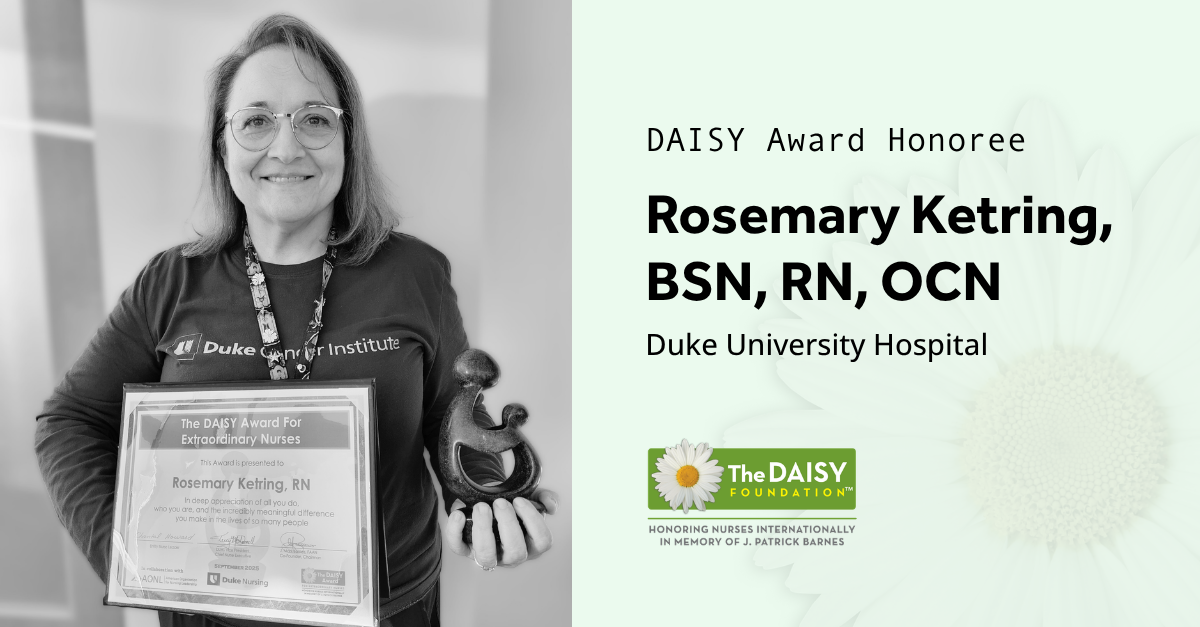
Sometimes the most meaningful connections happen when you least expect them. While accompanying her mother to an appointment at Duke Cancer Center, a member of the Propelus team met Rosemary Ketring, a DAISY Award® Honoree, and instantly knew her story needed to be shared.
Rosemary Ketring, BSN, RN, OCN, is a Clinical Research Nurse Coordinator at Duke University Hospital whose compassion, dedication, and impact have touched countless lives. In this conversation, she reflects on the moments, patients, and purpose that have shaped her nursing journey.
We hope her story inspires you as much as it inspired us.
In her own words
DAISY Award® Honoree Rosemary Ketring, BSN, RN, OCN, on the moments, the patients, and the calling that shaped her nursing career.
Propelus:
Can you tell us a little about your current role?
Rosemary:
As a graduate of a three-year nursing diploma program, I began my career at Yale New Haven Hospital, working in neuro step-down and the Neuro ICU. My career has largely focused on neurology, including spinal cord injury and neuro-oncology, allowing me to build deep expertise in complex patient care. For the past 12 years I worked as an outpatient neuro-oncology nurse at the Preston Robert Tisch Brain Tumor Center at Duke, and I recently transitioned into a Clinical Research Nurse Coordinator role there, where I get to connect patients with clinical trials—using my experience to understand their journey, help navigate barriers, and build the trust and communication needed to keep them engaged, while continuing to grow my research skills.
Propelus:
Take me back to the beginning—what inspired you to go into nursing?
Rosemary:
It really started when I was about 9 years old and helping care for my grandmother who lived with us. I remember being fascinated by her home health nurse, watching everything she did—from giving medications and injections to preparing nebulizer treatments, always asking questions; she always made us laugh and always answered my questions. She even took the time to teach me how to set up the nebulizer so I could help with my mom’s supervision—an experience that stayed with me and sparked my desire to become a nurse.
I began volunteering in nursing homes and at St. Mary’s Hospital at 13 (wore a red and white pinstripe jumper—I looked like a candy cane), carrying that interest into high school, where I developed a strong interest in anatomy and physiology.
Propelus:
What do you remember most about your very first shift as a nurse?
Rosemary:
It really feels like just yesterday, though it has been nearly four decades. I remember the start of that first shift—excited, completely petrified, and maybe feeling a little invincible in my new white scrubs at 21, walking onto 6-2 where I didn’t know anyone. About an hour in, they called a code in the next room, and I remember watching the team respond, everyone knowing exactly what to do.
By the end of that first shift, I was mentally and physically exhausted, still a little scared—so scared I almost forgot to leave the narcotic keys with my preceptor after we counted together—and thinking, I have a lot to learn, but yes, this is what I really want to do. I drove back to my little apartment, replaying everything that had happened, and drowned my fears and excitement in a bowl of chocolate ice cream—my go-to then, and sometimes even now.
Propelus:
If you could go back to that version of yourself, what are three pieces of advice you’d give to make the transition easier?
Rosemary:
- Give yourself some grace—you are learning something new.
- Be yourself—the best version of yourself. Be open to feedback and reciprocate with honest feedback. If you don’t understand, say that. It’s ok. Your preceptor really DOES want you to succeed. Yes, the older, experienced nurses may be hard on you, but still take the time and listen because they have excellent advice and knowledge—they were you once too, and they want you to succeed too!
- You ARE human. You WILL make mistakes (we all do), you WILL learn from those mistakes, you WILL move forward, AND you WILL be a better nurse because of it. YOU GOT THIS!
Propelus:
What have been some of the most challenging moments in your career, and how did you navigate them?
Rosemary:
The Patch Adams Theory—humor, compassion, and communication are really my go-to. Some of the most challenging moments in my career have come with starting new roles or moving into a different specialty—it’s exciting but also humbling to go from being experienced to feeling like a novice again. I’ve learned to navigate that by giving myself time to adjust, staying open to feedback, and leaning on the knowledge and experience of those around me—and injecting humor helps me to remember that I am learning again and helps me refocus.
There are challenging moments with patients and families, and I’ve found that an open approach, clear communication, and humor can really help deescalate, diffuse, and redirect—win-win for all.
Propelus:
Can you share a moment that reminded you why you chose this profession?
Rosemary:
There have been so many moments over the years that reminded me why I chose nursing. Early in my career in the Neuro ICU, I cared for young patients who didn’t survive, and I was a part of the difficult conversations with their families, including discussing organ donation. It was always incredibly difficult, but showed me the importance of being present in those moments.
More recently, I cared for long-term glioblastoma survivors who faced aggressive recurrences of their disease, and walking alongside them again reinforced that same sense of purpose. These experiences remind me how meaningful it is to simply be there for patients and families during their most vulnerable times.
Propelus:
Can you share the story behind your DAISY Award nomination?
Rosemary:
The story behind my DAISY nomination involves a former basketball player with glioblastoma who was feeling overwhelmed and frustrated because the tumor was affecting his cognitive processing, making it challenging for him to understand his medications and treatment plan. He shared that he was very structured and relied on a calendar, so I created a simple one for him and explained everything using basketball terms—stepping in as “assistant coach” to guide him through it.
His wife later shared in the nomination letter that this approach, along with empathy and patience, helped everything click on a very difficult day, and that he went to his radiation appointment that day smiling and truly feeling seen, heard, and understood.
Propelus:
What did that recognition mean to you personally and professionally?
Rosemary:
The recognition meant a great deal to me, both personally and professionally. On a personal level, it was incredibly humbling and brought me back to the heart of why I became a nurse—to truly make a difference in someone’s life. It also reminded me that the small, everyday moments we sometimes take for granted—taking the time to explain, to listen, and to connect—can have a lasting impact on patients and their families.
Professionally, it reaffirmed my commitment to compassionate, patient-centered care and grounded me again in the core values of nursing. It also made me reflect on the idea that, over time, it can feel less like I chose nursing and more like nursing chose me—through the many experiences, relationships, and moments that have shaped my career. The recognition reinforced that I’m exactly where I’m meant to be.
Propelus:
What advice would you give to new nurses just starting out?
Rosemary:
I’d tell new nurses that it’s not always easy to take advice or be in a position where you’re being precepted, but it’s all part of the process. Those moments, even the challenging ones, are what shape you into a stronger and more confident nurse. Be kind to yourself, prioritize self-care, and stay open to learning—it all helps you grow into the best version of yourself.
Propelus:
What are you most excited about for the future of your nursing journey?
Rosemary:
I’m really excited to be stepping into research, which is something I’ve always been interested in but haven’t found the right opportunity until now. Being part of advancing brain tumor research feels especially meaningful, given how rare these tumors are (1% of all solid tumors) and how much impact new treatments can have. I’m looking forward to contributing to work that can improve both quality of life and outcomes for my patients.
Propelus:
Is there anything you’d want to say to the person who nominated you, or to your fellow nurses?
Rosemary:
I’m truly honored and honestly surprised that something I do and teach several times a day—and often take for granted—like helping your husband understand his care by explaining it in basketball terms and stepping into that “coach” role had such a meaningful impact on you and your family. It reminded me that even the moments that feel routine to us as nurses can truly make a difference for our patients.
I’m grateful to all the patients and families I’ve cared for over the years for constantly helping me reconnect with the core values of nursing—compassion, honesty, advocacy, and simply being present. To my fellow nurses, it’s a reminder that the work we do every day matters more than we sometimes realize.
Closing thoughts
Rosemary’s story is a reminder that nursing is rarely just a career. It’s a calling that finds you, shapes you, and carries you through even the hardest days. From a curious nine-year-old watching her grandmother’s home health nurse, to a DAISY Award® Honoree connecting brain tumor patients with life-changing clinical trials at Duke, her journey speaks to the quiet, extraordinary impact nurses make every single day.
We are deeply grateful to Rosemary for so generously sharing her story, her wisdom, and her heart with us. We also want to thank The DAISY Foundation™ for their continued partnership and their unwavering commitment to ensuring nurses everywhere feel seen, valued, and celebrated. And to Duke University Hospital, thank you for fostering the kind of culture where compassionate, patient-centered care like Rosemary’s can truly thrive.
This Nurses Month, Propelus is proud to stand alongside nurses like Rosemary and honored to be part of a community that believes the work nurses do every day matters more than words can express. Thank you.